
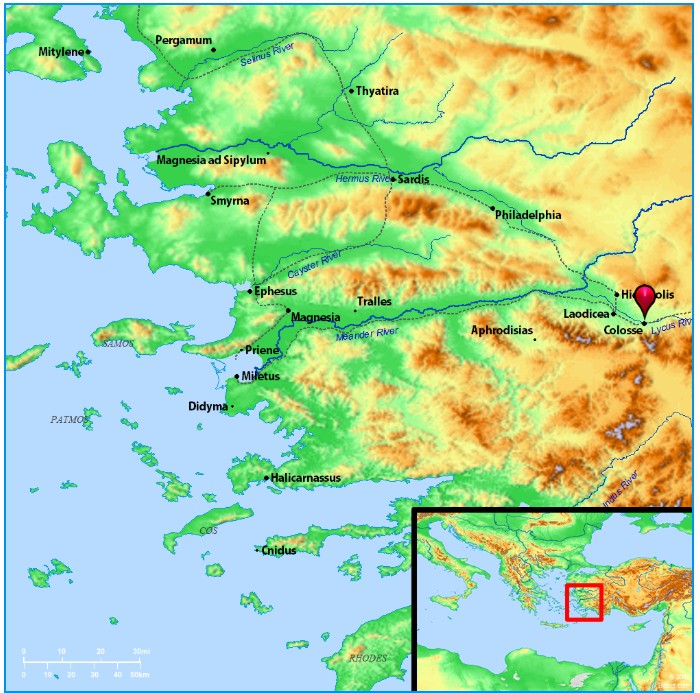
Colossae and Surrounding Region:
Overview of Paul’s Epistle to the Colossians:
- Laodicaea, Heropolis and Colossae were all cities in the same region of Asia Minor, East of Greece. The three cities were about 10 miles apart basically on the same trade route. Economically, Colossae slowly diminished to the richer Laodicaea. Heropolis was better positioned on the trade routes. According to the apostle John, Laodicaea was much richer (Rev 3:17)
- The church at Colossae (Col 2:1) was probably founded by Epaphras who was also connected to Laodicaea and Heropolis (Col 1:7; 4:12, 13)
- The church was mainly Gentile. Paul notes they were once aliens and enemies, strangers to the covenant (Col 1:21), clueless to the mystery made know to Gentiles (Col 1:27) and having a background of pagan sins (Col 3:5-6, 7).
- Cults… The “cults” or heresy in Colossae represented a syncretistic philosophy—a blend of Jewish mysticism, pagan folk beliefs, and Christian theology that undermined the supremacy of Christ. Key elements included the worship of angels, extreme asceticism, and reliance on visions, likely stemming from a diverse, cosmopolitan religious environment… The Gospel Coalition. Key Aspects of the Colossian Heresy:
- Worship of Angels/Intermediaries: Based on Reese Commentaries and SonicLight.com, believers were encouraged to venerate angelic beings as intermediaries.
- Asceticism: The false teachers practiced harsh treatment of the body (“do not handle, do not taste, do not touch” – Col 2:21), rooted in a belief that the material world was evil.
- Jewish Legalism & Mysticism: The teachings incorporated strict adherence to Jewish laws (circumcision, festivals, Sabbaths) mixed with pagan rituals and a pursuit of secret, visionary knowledge (gnosticism).
- Diminishing Christ: The philosophy likely suggested that Christ was not sufficient alone and that these intermediate spirits or practices were necessary to reach God.
- Colossae’s heresy that captured Paul’s thoughts and prayers:
- The heresy attacked the supremacy of Christ (Col 1:15, 19; 2:2, 3; 2:9)
- It attacked Jesus’ role in creation (Col 1:16-17)
- It had an astrological element (Col 2:8)
- It made much of the powers of demonic spirits (Col 2:10; 2:15)
- It had an element of the philosophical (Col 2:8)
- It dealt with special days and rituals (Col 2:16)
- It had an ascetic element (Col 2:21)
- It thought lightly of the physical or bodily sins (Col 3:5-6, 7-8)
- They worshiped angels (Col 2:18)
- They were spiritual and intellectual snobs (Col 1:28)
- It was based in the early teachings of Gnostic thought
- Paul insisted that Jesus was both the Son of God (divine) and man (flesh and blood) – Col 1:24
- Paul objected to rules and laws meant to control people according to teachings of men – Col 2:20, 21-22, 23
- Higher reaches of Gnosticism were open to only a chosen few. Ordinary men and women could never attain to these heights.
- In the first two chapters Paul addresses the heresies. In the last two chapters he outlines ideal church structure for spiritual life and growth
- We are “in Christ”
- Dead in Christ – Col 3:3, 5-6
- Raised up with Christ – Col 3:1
- Hidden with Christ, in God – Col 3:3
- Set your mind on these truths – Col 3:2
- Put on the “new self”
- New man – Col 3:10
- Renewed daily, without distinction – Col 3:11
- New heart – Col 3:12
- Chosen by God – Col 3:12
- Ruled by peace – Col 3:15
- Doing the word – Col 3:16
- Families of God
- Husbands – Col 3:19, 21
- Wives – Col 3:18
- Children – Col 3:20
- Working Godliness
- Slaves – Col 3:22
- Workers – Col 3:23-24
- Masters – Col 4:1
- Spiritual life
- Devoted prayer- Col 4:2-3
- Evangelism – Col 4:5-6
- Final greetings
- We are “in Christ”